Behaviour change is not marketing. At least not in the sense that someone like Byron Sharp would understand it. (It’s not about mental availability and distinctive assets.)
You are, of course, still selling an idea. For example, someone might go ‘smoke-free’ in their lives. Or take up exercise. Or read to their children.
But you’re not trying to shift a product. You’re aiming, first and foremost, to shift a mental state – changing a person’s inner world so that they can take (and sustain) effective action in their outer world.
The COM-B Model (by Michie et al) is probably the best-known Behaviour Change framework. Basically, Behaviour (B) is determined by a person’s Capability, Opportunity and Motivation (COM) to make the change. You need all three to make an impact.
COM-B is a useful model in the development of communications. But, to grasp the difference between ‘social marketing’ and ‘selling’, it’s probably easier to think about the personal process of Behaviour Change.
In the late 1970s and early 1980s, a team of researchers led by James O. Prochaska of the University of Rhode Island drew together a range of theories into an integrated model. (Prochaska had been motivated by the experience of growing up with his violent alcoholic father… who didn’t think he had a problem, and couldn’t change.)
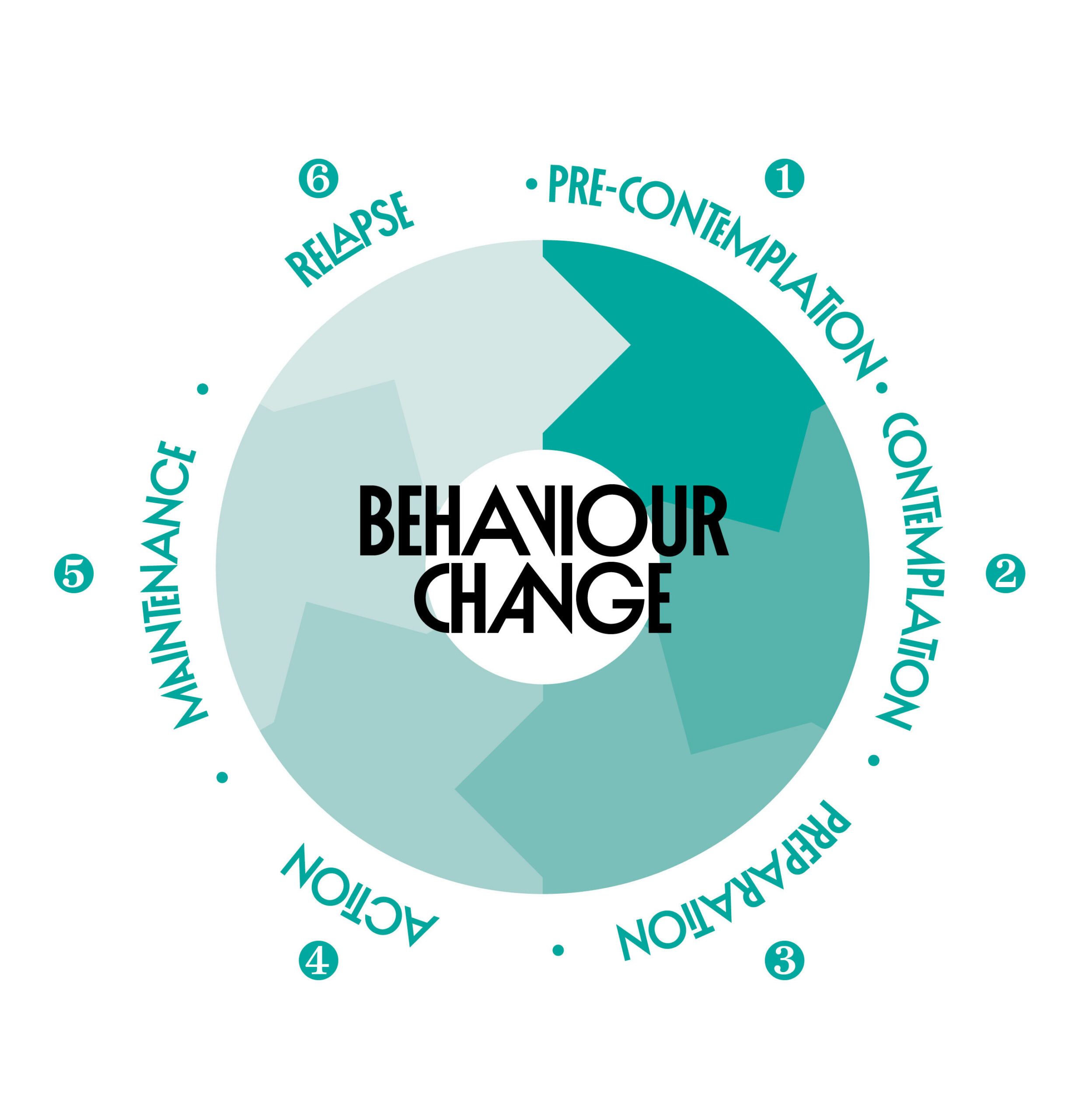
The Prochaska model of behaviour change shows how people move through different phases:
Pre-contemplation: this is like the infamous ‘unknown unknowns’. When someone doesn’t know they have a problem, or can’t see or agree on the need for change, there’s no way to move forward.
Contemplation: before you can change, it needs to dawn upon you that this might be necessary or beneficial. How do you think about where you are now, and give yourself the impetus to take action? (The idea that external motivation is the answer is, at best, hopeful. We all know that ‘carrot and stick’ can suppress behaviour or create performative compliance, but real change comes from within.)
Preparation: some people can leap right in and go ‘cold turkey’. But even the simplest of behaviour changes depends on having resources, tools, tips, support and back-up plans – or it tends to go wrong quite fast. For example, if you want to read bedtime story to a child every night, it helps to have some good children’s books to hand. But you also need to plan around other practicalities – like getting home on time, feeding yourself, getting the dishes done and so on.
Action: at some point, a person needs to decide to start a new behaviour (or stop or moderate an old behaviour). To be effective, this is intrinsically linked to a new vision of themselves. The more powerful, and socially connected / approved the new vision can be, the more likely change will be successful.
Maintenance: we all know the first flush of enthusiasm. You’re going to learn to tango. You invest in dance shoes and a rose for between your teeth. And then, when you find out you have two left feet, and that practising is hard… That’s when you need the discipline of a dance teacher, a tango partner, someone to hold you accountable.
Relapse: And because behaviour change is hard, relapse is more or less inevitable. (That’s why it’s not like buying a product – unless you’re the kind of person who’s forever taking things back to the shop.) Once you fall off, how do you get back on the bike? The answer is to go through the process again – that’s why behaviour change is a cycle, not an in-the-moment event like buying a can of fizzy pop.
When you think about Behaviour Change as a process, you can see the different types of intervention points, and the support that the audience needs at each phase.
Some of that is closer to conventional marketing – how do you surface the issue in people’s minds? (Bearing in mind that old-fashioned ‘creative’ shock tactics and finger-wagging don’t work.) How do you create a culture where self-image supports the right kind of change?
However, the more active parts of behaviour change plainly need ‘unconventional marketing’. Emotion and attitude do matter. But if you’ve ever seen people smoking outside cancer wards, you’ll understand that there are people who ‘know’ and even ‘feel’ they should change their behaviour, but won’t.
That’s why, to turn good intentions into better actions, you need tools and tips and support systems to really make behaviour change work.